

SEE THIS THINKING IN PRACTICE
When the system failed, the clinical work still had to continue.
An emergent Interventional Radiology procedure was waiting. The department could not reach the clinical system through its normal workstation path, and hospital technology staff were tied up with another active case. The immediate question was not how to repair every affected workstation. It was how to restore enough dependable clinical capability for the team to make the next safe decision.
Working directly with Epic support, I served as the on-site clinical and technical liaison, performed the vendor-directed recovery on two IR workstations, helped validate the restored clinical workflow, and kept clinical and enterprise decision ownership clear.
Formal case study: Restoring Clinical-System Access During an Emergent IR Procedure
The problem was technical. The consequence was clinical.
When the IR team arrived, normal clinical-system access was unavailable across the department. General network connectivity remained available, but the usual path to the primary server was not usable from IR. If dependable access could not be restored, transfer to another hospital in a different health system remained a contingency.
With the normal technical response temporarily constrained, I stepped into the adjacent work the team needed while preserving the boundaries that mattered: Epic support directed the vendor-specific technical recovery, the interventional radiologist retained full clinical decision authority, and hospital technology retained ownership of the broader remediation.
Restore what the work actually requires.
Epic support identified a temporary recovery path through a functioning backup server. Under their direct instructions, I reconfigured two IR workstations. Two was enough for the immediate clinical need, so the intervention stayed bounded rather than expanding change during a time-sensitive event.
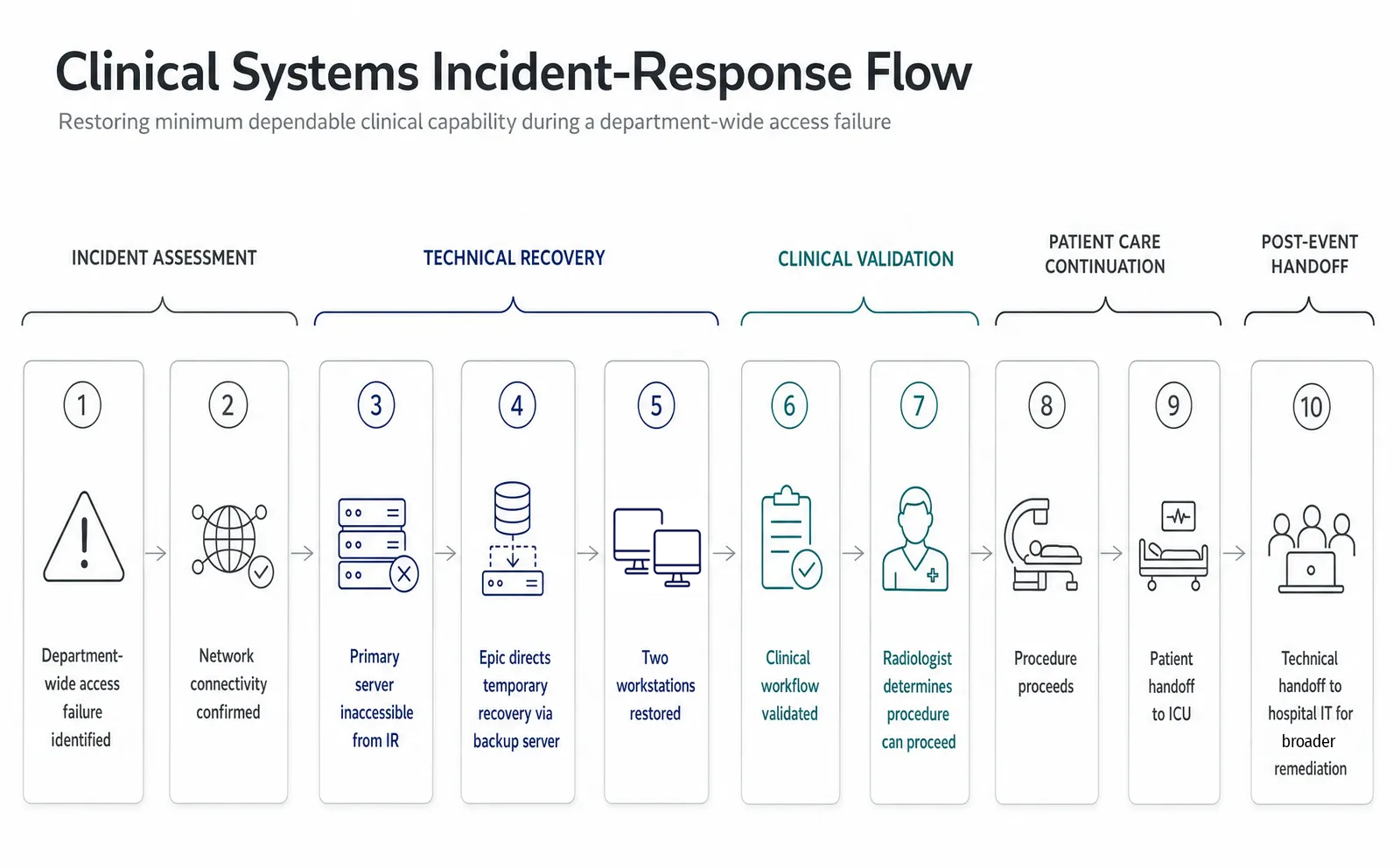
Restore the minimum dependable clinical capability required for patient care first, validate that capability in the real workflow, preserve decision authority and contingency options, then transfer the broader systemic problem to the team responsible for permanent remediation.
A technical fix is not a clinical solution until the workflow holds.
A successful login was only the beginning. We verified access to the relevant Emergency Department information, correct patient context, expected linkage of IR scout scans, and the clinical information required for the procedure through the restored workflow.
The interventional radiologist then determined that the team had what it needed to proceed. After the procedure, patient handoff to ICU came first. Only then did I return to the systems issue, walk hospital technology through the observed failure, the Epic-directed changes, the temporary recovery path, and the validation performed, and hand broader remediation back to the team that owned it.
What this reveals about how I work.
I am especially effective when clinical reality, healthcare technology, workflows, and information stop lining up neatly. I tend to start with the actual constraint, separate what is known from what is assumed, make the smallest justified intervention, test it where the work really occurs, and keep ownership clear.
When the team needs something adjacent to my formal lane, I am willing to step into that work when I can do so responsibly. The goal is not to be the hero. It is to help the team move forward, make the work dependable, and stay with the problem through a clean handoff.
Go deeper.
This page is the abbreviated story. The full de-identified case study documents the incident sequence, role boundaries, controlled recovery, workflow validation, evidence limits, and retrospective clinical informatics analysis.